Ethernet
Separate WAN and LAN connections for machine-side and uplink networking.
 Industrial hardware, explained.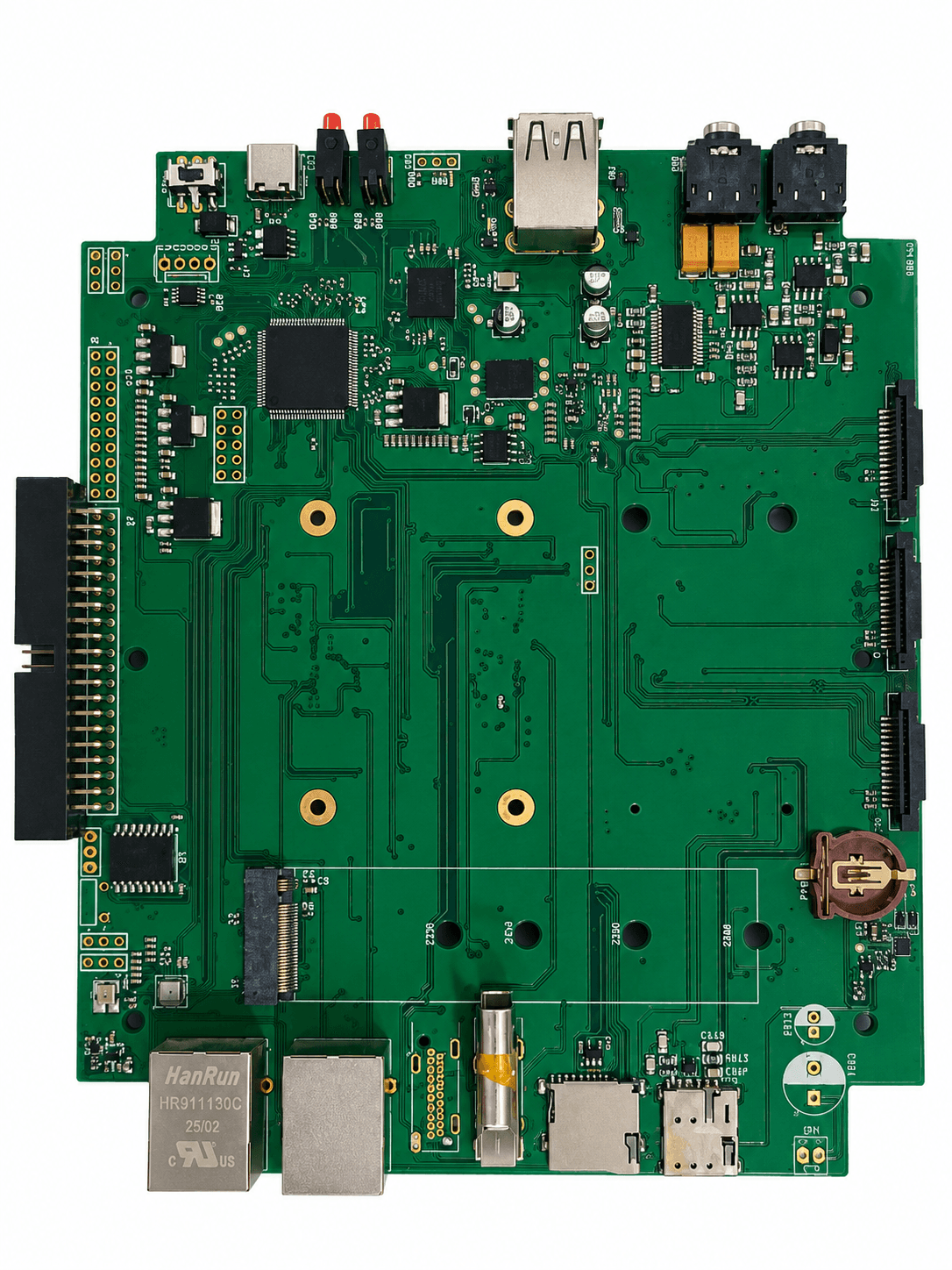
Development boards
Raspberry Pi CM4 platform for intelligent industrial edge applications.
An advanced AIoT development platform based on Raspberry Pi Compute Module 4. It combines edge AI, cellular connectivity, dual Ethernet, Wi-Fi and hardware expansion in an industrial-ready base.
Hardware, connectivity, power and expansion details.
Core features
Suitable applications
Communication and interfaces
These are the supported hardware interfaces and protocols stated for this product.
Separate WAN and LAN connections for machine-side and uplink networking.
GSM / 4G and Wi-Fi options for connected deployments.
Pins for sensors, indicators and custom hardware.
Peripheral, display and audio interfaces for an HMI or prototype.
Student view
Use it as an edge-computing lab platform: acquire data, process it locally and publish useful results.
Example projects showing what this product can read, control and report. Each requires the appropriate sensors, connected equipment and application software.
Example: connect a compatible USB camera above a conveyor. The CM4 runs a vision application with Hailo acceleration to flag missing parts or visible defects, then displays inspection results over HDMI and saves records to microSD.
Example: process a camera feed locally to count packages passing a checkpoint. An application sends count updates over Ethernet, Wi-Fi or 4G so a supervisor can compare actual movement with dispatch records.
Example: connect compatible condition sensors through suitable interface hardware. Software analyses readings on the CM4, records changes and sends alerts when a configured threshold or trained model identifies an unusual pattern.